 KOOROW
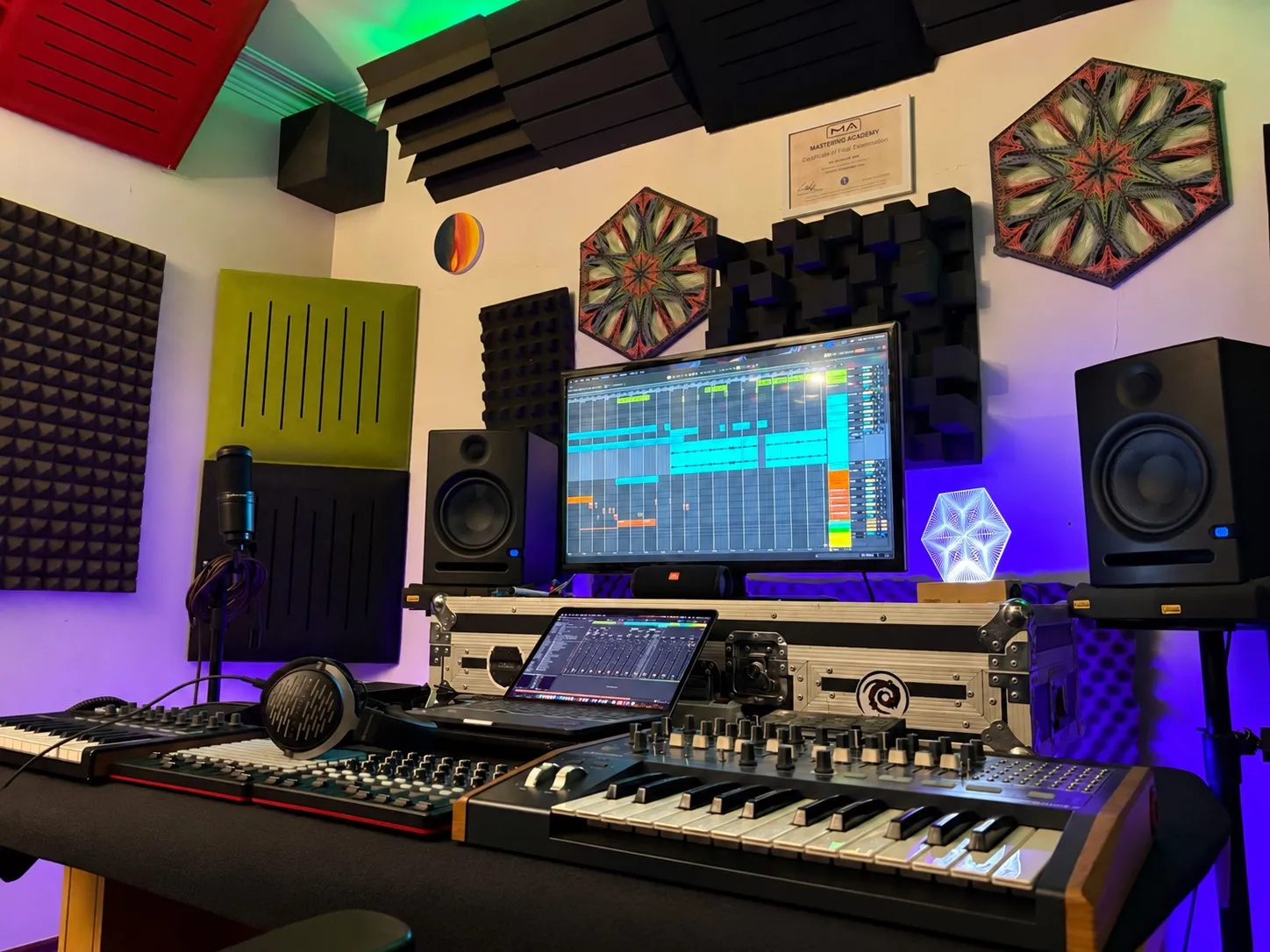
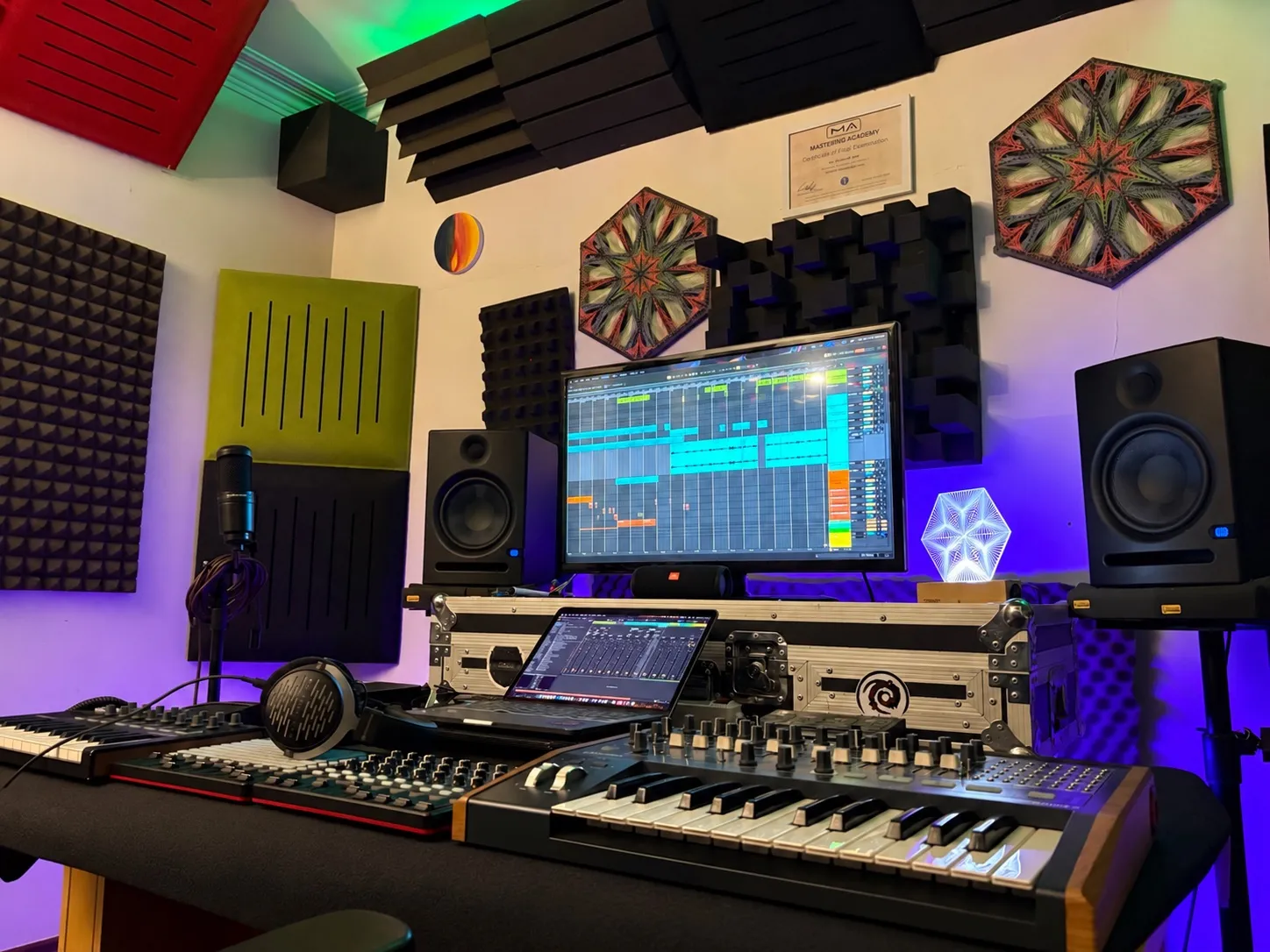
This is not a polished tutorial. It is a real class session in KOOROW’s studio. One of his students brought a Behringer Neutron, and they patched it together with KOOROW’s Arturia MiniBrute to build psytrance sounds: FM, sample-and-hold effects, shared MIDI and live performance. Here is how the two semi-modular synths were connected and why each cable matters.
The video is in Persian. This article walks through every step in English.
Why patch two semi-modular synths together
- In KOOROW’s opinion the Behringer Neutron is one of the best synths for our genre. Both it and the MiniBrute are semi-modular.
- With patch cables, one synth can borrow what the other has. If you run out of oscillators or LFOs on one, take them from the other.
- One synth’s oscillator can control something on the other synth, without recording its audio at all.
Step 1: Get notes into the synths
To play the synth from Ableton, connect a MIDI cable from your audio interface’s MIDI out to the synth’s MIDI in. Generate the notes in Ableton however you like: an arpeggiator, a sequencer or simple hand-written notes. Another option is to take the MiniBrute’s sequencer output into the other synth’s MIDI input.
In Ableton, KOOROW sets up:
- An audio track with External input, set to the interface input the Neutron is plugged into. That is how you hear and record it.
- A MIDI track with a rhythm-generating MIDI effect. He barely touches it: only the probability of 1/8 notes goes up, at a rate of 1/16, and it keeps generating different rhythms.
- The MIDI track’s output goes to the audio interface (a Komplete Audio 6), whose MIDI out is cabled to the synth.
Step 2: FM with control
The first patch: take oscillator 2’s output from one synth and use it to modulate the Neutron’s oscillator 1, which is FM. But instead of patching it straight in, he routes it through an attenuator first.
The attenuator works like the blue amount ring around a knob in Serum: it sets how strongly the modulator affects the target. Patched directly, there would be no control over the FM amount. Through the attenuator, turning one knob sweeps the FM from subtle to full.
Step 3: Change of plan: sample & hold plus FM
Then KOOROW rewires it for a different idea:
- An LFO in sample & hold mode, at a set rate, goes through the attenuator into the Neutron’s oscillator 1. That is not FM. It is a sample-and-hold effect, with the pitch jumping to random values.
- For the FM, the Neutron’s own LFO goes directly to its oscillator 2.
- On the MiniBrute, its sample & hold goes to its own oscillator 2 pitch, with the rate turned up. You can see the LED blinking.
Now the oscillator mix knob becomes a performance control: sample & hold on one side, FM on the other, and both together in the middle.
Step 4: One rhythm for both synths
A second MIDI cable goes from one synth’s MIDI THRU to the other synth’s MIDI IN. The notes coming from Ableton pass through the first synth into the second, so the same rhythm generator now plays both. Before this, KOOROW had to play the sound by hand. Now pressing play in Ableton starts both synths together.
Step 5: Borrow an LFO for the cutoff
It would be cool to have a modulator moving the cutoff, but the sample & hold is already in use. The solution: the LFO has a multiple output, which gives a second copy of the same LFO. That copy goes to the other synth’s filter modulation on the cutoff. The trade-off is giving up the FM for a moment.
The LFO was moving very fast, so he lowers its rate and adjusts its amount. When it closes the filter too much, he reduces the amount again. A delay is also on, with high feedback but a very short time, so it acts more like doubling.
Step 6: Play it like an instrument
These synths are instruments, so the last step is to play them. With this patch, the key parameters are:
| Parameter | What it controls |
|---|---|
| The LFO’s rate | Oscillator 2 and the other synth’s cutoff, both through cables |
| The sample & hold LFO | Oscillator 1, via the cable and attenuator |
| The Neutron’s sample & hold | The other synth’s oscillator 2 |
Moving any of these while the rhythm runs creates great sounds. That is the fun of semi-modular gear: the cables decide what talks to what.
Learn sound design hands-on
KOOROW’s private classes are practical and project-based, on software or your own hardware. Koorow Premium adds weekly lessons, presets, samples and feedback on your tracks.